Pages

Showing posts with label projects. Show all posts

Thursday, April 2, 2015

paper eggs


Last year I designed these paper eggs to go along with Easter festivities. My little guy had fun painting some today, so I thought I would bring them back this year. They are a fun addition to Easter baskets, egg hunts, and make a cute accompaniment to place settings, too. 


There are three options for printing, small patterned (above), small blank, and large blank. You can paint/doodle/glitter/washi tape/decorate as much as you and your little ones like, then cut them out, and sew them up. 

I sewed them 3/4 of the way, filled them with candy and trinkets, and then sewed the rest of the egg while holding it shut with my fingers. 


Make sure you print two pages for each set of eggs, one for the front and one for the back. 


I used my sewing machine to quickly sew these, but hand sewing would work just as well. Just make sure the materials you use (paper and thread) aren't so thick that you can't rip the eggs open. 


I used a light-weight cardstock and normal thread, and they ripped easily. No need to back-stitch or do a really careful job of making perfect stitches, (which makes them the perfect project if you are anything like me!).


Here are the links to the templates:


Happy egg-making!

Monday, February 10, 2014

dresser makeover

A few months ago, I was on the hunt for a dresser for our bedroom. I didn't want to spend a lot since we are wanting to install a good closet system in our closet someday and completely do away with a dresser in the bedroom. But for now it's needed. 

My search took me to Ikea, the Tarva to be specific. The great thing about this dresser is that it's the perfect blank slate. With a little paint (or stain), some new pulls, and a few hours on a Saturday, this dresser can pretty much turn into whatever you want. 


I used Ace Cabinet, Door and Trim paint, colormatched to Benjamin Moore's Chelsea Gray, and Martha Stewart Bedford pulls (from Home Depot) for the hardware. I love these pulls so much, I'm sure I'll use them again for future projects. 

I have used Ace's Cabinet, Door and Trim paint for a number of projects, including painting our upstairs trim and molding, dressers, a bookshelf, and have even repainted a few past projects using this paint because it holds up so well.  I LOVE it. It dries rock-hard and super smooth, it's my favorite paint for projects like this. 


I love how it turned out. The only thing I might change in the future is the legs, they are a little skinny and don't quite go with the look I like. They look a little harsh to me or something? But until I find some other legs I like for it, I'm calling this project done. 

My original plan was to camouflage the TV with a small gallery wall (I know some people get crazy about TVs in bedrooms, but my husband and I are crazy about watching movies cuddled up in bed, so you gotta do what you gotta do, eh?), but I kind of like the layered look, too. Maybe layering another picture or two around the "L" will be enough? We'll see where it ends up. 


So for now, the dresser is done, the styling is a work in progress, and we have enough room for our clothes (hooray!). Our bedroom is slooooowly coming together!

Have you tackled any fun projects lately?

++UPDATE++

I get a lot of emails about this dresser, so I'll answer some of the most common questions to hopefully be a little more clear about my painting process.

The wood grain on this dresser is really pronounced and has a lot of texture, so even though I used a good, thick paint, it still shows through. I don't mind this (I even like it!), so I just painted one coat of paint and was done.

If you want to hide the wood grain a bit I would suggest sanding the dresser first, and then applying a primer. You might even want to use wood putty over some of the bigger knots to make them less obvious. I did none of this, however. I did not sand, use primer, or use a sealer at the end. I literally just painted the dresser using a foam roller and paintbrush, added the hardware once the paint was dry, and never looked back!

I've used this dresser daily for over a year now, and it's held up great. If you want a more glossy finish I would suggest sealing the paint, but mine has held up beautifully and looks just as good as it did the day I posted these pictures.

Hope that helps!

Wednesday, January 29, 2014

make it: faux brass vase


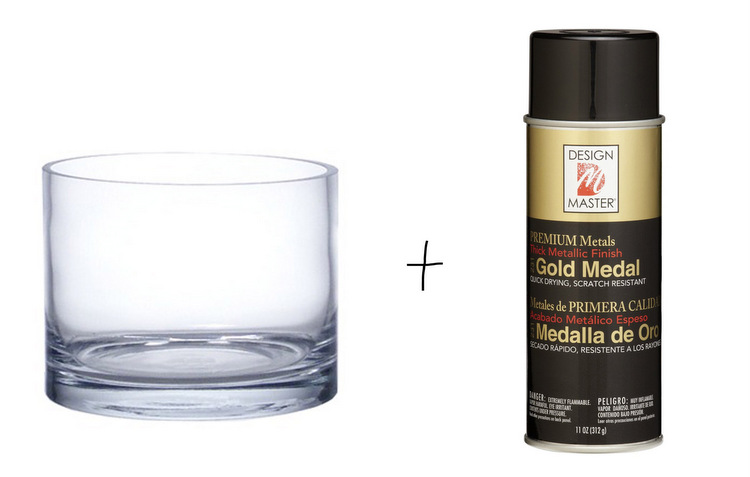
I've been kind of obsessed with having a simple, brass vase for a while now. I can't for the life of me remember where I got this link, but these gorgeous vases (particularily the 6 inch cylinder) were burned in my mind and I had to have one. I almost ordered one a few months ago, but I was confused about shipping and the minimum order, so rather than just ask (like a normal person?) I waited. And then, on a random trip to Michaels  I found the right size cylinder, only in glass. I thought, if only it was brass. Sigh. And then I remembered this little thing called spray paint and this little brass-vase-knockoff was born. 

This project is pretty straightforward: thin coats of spray paint on a vase of your choosing. Lightly sand any drips or bubbles, and then do your final coat. To get more shine you might want to spray a glossy sealer on it at the end, I haven't tried that but kind of want to to see it it makes much of a difference shine-wise. 

I used Design Master in Gold Medal and love the color. It looks so great in person. I added little felt feet to mine once it dried so the paint won't ever rub off on my table. I don't know if that's even something that might happen, but since it will be on a white surface I didn't want to chance any rubbing. 


I really love how it turned out! In person it looks a lot more like brass than my pictures show, but just not quite as shiny as the real thing. It's a great alternative though, and the cost was super low, just a few dollars for the vase and spray paint. (I used my Michaels coupons, so maybe it was $4 for spray paint and $2 for the vase? More than that without coupons, of course)


Add some gorgeous freesias from Trader Joe's, and I've got a pretty little arrangement to brighten my living room. I'm loving the smell of these flowers, they are seriously making me want spring!

Monday, January 20, 2014

quick and easy potted succulent (that won't die!)


Like most people these days, I've got a thing for potted succulents. They're just a fun addition to a room, and are pretty hard to kill. Unless you're me. I live in Seattle, so my house isn't exactly flooded with sunshine for a lot of the year. If I keep them in a window, or close to one, they are fine, but I like them on shelves and tabletops, too, and those always end up dying after about six months. It's pretty sad. 

So after finding some very real-looking faux succulents at Hobby Lobby a while ago, I've been replacing my dead ones with falsies haven't looked back. (I know I said not too long ago that I'm not a fan of faux flowers, but that's because you can always tell when flowers are fake. These look so real, so I give them a pass!)


My workspace was needing a little freshening up, so I decided to use one of those succulents to add some green. Since dirt isn't needed, and the succulent looked weird just sitting in a bowl, I grabbed some rocks from my yard and made a very quick potted succulent that I never have to worry about again. 


All you need is a faux-succulent, rocks, and a cute bowl. I got mine at Target a while back, but don't think they have these particular ones anymore. They always have something cute though, so you could easily find something there. West Elm and Anthropologie have really cute ones too, and Home Goods and T.J.Maxx never fail me either. Or just use what you have, I'm sure you've got a cute bowl lying around, right?

Simply put the succulent in the bowl and place the rocks around it to keep it from moving, as well as to fill the extra space in the bowl. You don't want to be able to see the stem. And then you're done! You never have to worry about watering or shriveling, lucky you!

If you want to get all fancy, you could use a real succulent and dirt instead of a falsie and some rocks. I won't judge you for that :)


I'm loving the green on my desk, and I love it even more that I don't have to replace it in a few months!

Friday, January 17, 2014

make it: diy slipcovered headboard (with piping!)


My little one turned three this past fall, so I've been slowly working on transforming his nursery into a big-boy room. Out went the toddler bed, in went the twin. And of course, I had to make him a headboard. (Of course!)

There are other elements in his room that are busy (rug, roman shade, book wall, bedding...) and I'm not ready to change them just yet, so I wanted his headboard to be something neutral. I found some old curtains in my stash that I had cut up to make roman shades for my bedroom (I have finally found the best way to make them! Can't wait to share!), and had just enough fabric left over to make a headboard.


Since the fabric is so light, I wanted something that I could throw in the washing machine if I need to. Because really, white + three-year-old does not stay clean. So I decided to try and sew a slipcovered headboard. I tried to find a tutorial or something to follow but couldn't find what I was looking for, especially since I wanted to add some crisp, black piping to it. So I made it up as I went and am so, so happy with how it turned out!


I didn't take pictures along the way since I didn't know if it would even work and look the way I wanted (and it was super late at night!), so I made some sketches of what I did, hopefully they'll do. 

I'm sure I'm going to over-explain and make it look way harder than it is, so if it doesn't make sense just ask and I'll do my best to clarify! Ok....here goes!

First, you need a headboard to cover. If you already have one, great! Move right along to the next step. If you don't have a premade headboard, you can make one with just a few extra steps: 

+ Cut plywood or MDF to the size you want your headboard to be.

+ Cut foam to the same dimension as the wood, and adhere it with spray adhesive. I've found that buying foam mattress pads is much less expensive than buying foam at the fabric or craft store. Just fold the pad in half to double the thickness, and it usually works great. I've also had great luck getting foam at Fred Meyer, in the tool/home section. So if you have one of those (or Kroger? Is it the same thing?) you might want to check it out. 

+ Cover the headboard with batting, securing in the back with staples. Make sure everything is nice and smooth, and that corners are tight and secure. 

There are tons of tutorials that are way better than that (with pictures, too, I'm sure!) so if you need more explanation just google or look on Pinterest for diy headboards and you will find hundreds of ways to do it.

Now we can move on to the slipcover...

You need to cut five pieces of fabric, A, B, C, and D:


A:  Front panel = width + 1 inch x height + 1 inch (cut TWO of these, one for the front, one for the back, or see the *note at the bottom)
B:  Side panel =  width of side + 1 inch x height + 1 inch 
C: Side panel, same as B
D: Top panel = length + 1 inch x width + 1 inch 

The "+ 1 inch" allows you to have 1/2 inch seam allowances, so keep that in mind when piecing your fabric together.

You also need to get some piping (if you don't want piping you can omit this step, I promise it's not that hard, though!) Measure the perimeter of the sides and top of the headboard to determine how much piping you need. I just buy my piping pre-made. The pink below is where your piping will be, so this is what you measure.
Sew the piping to panel A. Here is a good tutorial about sewing piping. The piping gets sewn to the right side of the fabric.
I don't have a piping foot so I just used my zipper foot and it worked just fine. Start at the bottom of one side and sew all the way up and around to the bottom of the other side. 

Sew panels C, D, and B together, making a long strip (yellow marks where the seams will be). I pinned my fabric together on top of my headboard (like you would use a dress form to make clothes) to make sure I got the right fit. I don't always trust my measurements :) I think that made it so much easier, nothing had to be measured perfectly, I just pinned everything wrong-side-out and made sure the seams were in just the right spot. 

Picture 1 shows what it looks like if you pin it on the headboard, picture 2 shows what it looks like laid out in a long strip.


I'm calling that last step, the big long strip, panel B.

Sew B to panel A, making sure the seams are in the right spots, and right sides are facing each other. This will sandwich the piping between A and B, so make sure corners are snipped, seams line up, and you sew nice and straight. I didn't clip my corners (oops), and one turned out a little bunchy, you can see it in one of the photos at the top. Refer back to that tutorial if you need help with the piping. 

The most important part of this step is making sure the seams are in the top corners. It's probably most helpful to pin each corner in place, then pin the top, and then the sides. 

Don't forget, pinning it while it lays on your headboard makes it so much easier. Drape panel B over the headboard, exactly how you want it placed, with right-sides down, and then pin it to panel A. There will be no surprises with the fit or where seams end up if you do it this way.

Now sew the whole thing, starting at the bottom of one side, going up and around, and ending at the bottom of the opposite side. 

Next, attach the back panel to panel B just like you did with panel A. 

*Note: You can add more width to the sides and just wrap them around the back of the headboard, rather than attaching the back panel. Secure it with a few staples, and you will still have the slipcovered look without the back panel.

Now you can either hem around the bottom of the whole thing, or simply tuck it under the headboard like I did. 


Turn everything right-side-out and slip it over your headboard. It should all line up and be everything you've ever dreamed. Angels will sing, and happy tears will flow. You have been warned.

Good luck, and let me know if you have any questions!

Tuesday, January 14, 2014

make it: coffee filter flowers


I loooooove fresh flowers. Love them. (Who doesn't, right?) I've told my husband that I'll know we've "made it" when I have a standing order at the florist for fresh flowers delivered every week. Wouldn't that be nice? A girl can dream. 

With that being said, I'm not a huge fan of fake flowers. I just don't feel like they even compare, you know? I do have a soft spot for paper flowers, however. For some reason, in my brain, paper flowers are sweet and whimisical, and can stand-in for the real thing in a pinch. 

So here's my way to make some pretty paper flowers out of coffee filters. I like using coffee filters because they take color really well, so you can make them whatever color you want. I tried a few techniques for coloring, and they all turned out pretty (I'll get to that more at the end). Let's do this.

What you need: 

coffee filters
scissors
wooden skewers
floral wire
floral tape
water color paints/food coloring + water

What to do:  


1. Use 4-8 filters per flower. The more filters you use, the more full and bunched the petals will be, like a carnation. Using less filters will make it look more like a peony.

Stack your filters on top of each other and fold them into thirds; folding them in half, in half again, and in half again.


2. Scallop the edges. This gives the petals their shape at the top, so experiment with what look you like. Large scallops or points would make pretty flowers, too.


I set half of my filters aside and cut them the same way, only I made them smaller by taking more off the edges. The flower bunches better and looks more realistic if the filters are smaller in the middle, and I found that taking 2-3 inches off looked best to me.


3. Lay your filters out flat, with the smaller filters on top. Coming from the bottom, poke the floral wire up through the center of the filters. Pull the wire up and poke it back down through the bottom, (kind of how you would sew with a needle) leaving at least a quarter inch between holes (you don't want any ripping!)


Twist the wire in the back to secure it.


4. Now it's time to bunch the filters and shape the flower. Start with the top filter and scrunch it between your fingers. It naturally scrunches pretty well, but you will want to shape it.


Continue scrunching until the flower is completely shaped.


5. Wrap the floral wire around the base of the flower, making sure to keep everything nice and tight.

You can wrap just your base and wire with floral tape, or you can stick a skewer in the base and wrap it as well. I like doing this if the flower will be in a vase, it keeps it nice and upright.

Once things are wrapped nice and tight with the wire, start at the base of your flower and use your floral tape to wrap all the way down the wire (or skewer).


7. Now comes the fun part, the color!

I have experimented with three ways of coloring these:

+ Painting the finished flower with watercolors (as pictured above)
+ Dying the filter in a food coloring/water mixture before you make the flower. Make sure to let the filter dry all the way before using it. (The pinkey-orange filters in this post were made this way)
+ Dipping the finished flower in the food coloring mixture and letting it dry 

All of these methods made pretty flowers. Dipping the finished flower was the fastest way to color it, but one flower did slip out of the floral tape and fell apart, so keep that in mind. It was fun to mix food coloring and get varied colors on the filters, but I also love the look of the ones that have been hand-painted. They look the most real to me and dry pretty stiff, so they might be more protected from little hands.  

Now you can enjoy some long-lasting flowers in your home. Maybe they can help chase away some January blues? 


Tuesday, July 2, 2013

make it: 4th of July bunting


Anyone have fun plans for the 4th of July? We are having a small barbecue at home, and what's a barbecue without bunting? Of course I had to make some for the festivities, and I shared the project over at thinkcrafts.com. Hop on over to check it out!


P.S. how cute would it be to wear this on the 4th?

Thursday, June 27, 2013

make it: mouse pad


Wow, it's been a while! I've been busy with projects around the house, which is always good, but we keep skipping from project to project and don't have much to show except a bunch of random half-done projects! On Saturday my husband and I made a list and decided we won't start anything else until we finish up the projects on that list, so hopefully I'll have some fun things to share soon. Does anyone else get like that with projects? It's like we get so excited to start something new that we skip around and nothing gets finished! 

In the meantime, here's a small project I did for thinkcrafts.com. Hop on over to see how to make your own mouse pad!


This little office nook is so close to being done, I can't wait to share the finished space with you!

Tuesday, May 28, 2013

make it: magnets

I'm one of those people who thinks that even the little things in my life should have some amount of whimsy or beauty, and after staring at my fridge one day lost in deep thought (I'm sure... :) I realized that I've  never given much thought to magnets. Silly? Maybe. But they hold up all my favorite photos and pieces of art made by my favorite two-year-old, and I see them multiple times a day, so why shouldn't they be a little more special than a chip clip?

So with magnets on the brain I have two projects to share with you over at thinkcrafts.com.


First up, watercolor magnets (I will never tire of watercolor!)


 And then we have washi tape magnets (you can use pretty paper if you don't have washi tape).

Each project is super simple and quick, so have some fun and spice up your refrigerator!

                                                                                                                            ▼▲▼▲▼▲

In other news, how was everyone's long weekend? We tackled painting the trim and walls in our master, it makes such a difference and I can't wait to share! It seems like our bedroom is always the last to get decorated (if at all!), so we decided it's time to change that and give ourselves a nice room to relax in at the end of the day. It will be a while until it's done, I'm sure, but I can't wait to share everything along the way!


Wednesday, May 1, 2013

instagram art (and how to print your instagrams for cheap!)


Hi, my name is Erin, and I'm addicted to Instagram. It's a fact. And a few weeks ago I found myself lost in my Instagram archives, reminiscing and smiling at some sweet pictures and even sweeter memories. Then I started thinking about a frame I bought at IKEA a few months ago that had been sitting empty next to the kitchen table while I found the perfect tea towel to put in it. So I started thinking about that frame and all of the pictures and how who the heck knows how long it's going to take me to find that perfect tea towel to frame, so I decided to fill that frame with Instagrams (I kept picturing this picture that I've loved forever, only on a much smaller scale). Yay for one less empty frame! And yay to you for making it through my crazy long thought process!

I've looked into several options for printing Instagrams, but let's face it, when you want to do a project you don't want to wait for them to get mailed to you, and the app that sends them to Walgreens was not working right and it was bugging the heck out of me, so I decided to just straight up print them old school.

Here's two ways that you can print them at any photo center (I use Costco), the finished photos will be 4x4 inches:

Photoshop Elements:


Import your Instagrams into PE, then click on File --> New --> Blank File.


That will open this screen. Under the "Preset" drop-menu, choose "Photo". Under the "Size" drop-down menu choose "Landscape 4x6". Make sure the color mode is RGB Color and the background is white. Hit OK. 


That will open up a blank 4x6 canvas. Drag your Instagram into the blank canvas. 


Size it so it fills the canvas from top to bottom, and then save. This will be the finished photo that you send to the photo center just as you would a normal picture. Again, these Instagram's will be 4x4 inches when done. 

If you don't have Elements you can download Picasa for free and do it there, here's how:

In Picasa:


Open your Instagram in Picasa, go to "Create" along the top left, and choose "Picture Collage." 
Once that opens up, under "Settings" choose "Picture Pile." Make sure that under "Page Format" the size is 4x6. Then straighten and size your photo to fill the white canvas. There will be space on the sides, as shown in the picture above. 

Then save your photo, and send it to your photo center just as you would any other picture. 

I sent mine to Costco, so these were $.13 each. 


This is how the printed photos will look. (Sorry for the crappy phone pictures!)


Trim off the white edges.


Then arrange them in your frame. I arranged them and then taped them down, it worked like a charm.  


I'm pretty much I love with it. I think it makes the space a little more fun and I love being able to enjoy the pictures I take on my phone. Because seriously, I capture some of the best photos on that thing!
I also like that I can switch a few out when I get the urge for an update. 

So have you ever printed Instagrams? What did you do with them? I'm kind of thinking of printing some more and sticking them  on my refrigerator. I think it's so fun when refrigerators are covered in pictures!
Related Posts Plugin for WordPress, Blogger...